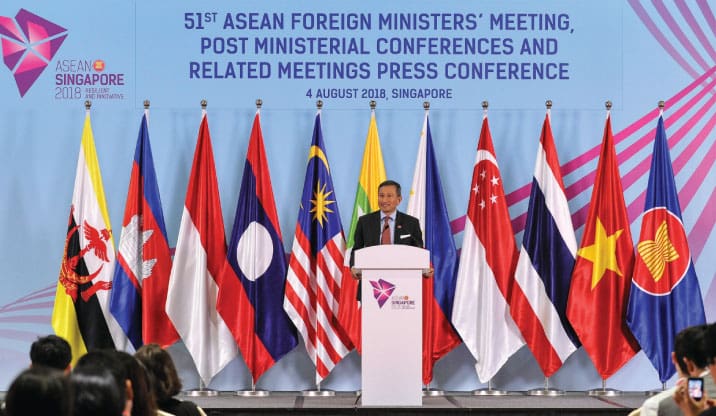
Photo: Singapore Ministry of Foreign Affairs
Round up of highlights of the meeting in August held in Singapore by Foreign Minister Dr Vivian Balakrishnan
SINGAPORE’S Foreign Minister Dr Vivian Balakrishnan in his round-up speech to journalists at the end of the 51st ASEAN Foreign Minister’s Meeting was happy to report, “This is my third ASEAN Foreign Ministers’ Meeting and I can honestly say this has been the smoothest, the least contentious, and the most constructive and positive meeting so far. So it has been on a good trajectory.”
Delving into the details of this year’s gathering he first highlighted how it marked a handing over period of the coordinatorship. For example, Singapore has been the coordinator of the ASEAN-China Dialogue Partnership for the past three years and said he had briefed the ministers of the positive developments there and, “We’re now the new coordinator for the ASEAN-EU relationship. And I’ve had some preliminary discussion with Federica Mogherini who is in-charge of the Foreign Affairs and Security for the EU. For a start, the EU has indicated their support for our ASEAN Smart Cities Network and we will explore various avenues to do more together with them. We’ve also agreed to conclude the negotiations on an ASEAN-EU Comprehensive Air Transport Agreement which we hope to do by the end of this year. And we will resume negotiations for an ASEAN-EU FTA.
He stressed these were just some of the ideas discussed and will be looked into by the EU and ASEAN members. “The point is that there is a substantive agenda that ASEAN and EU can work on in the years to come. And we will play an active role in this.”
He also drew attention to the demonstration projects of the ASEAN Smart Cities Network (ASCN) that included e-commerce, remittance of money, as well as the introduction of an action plan for 26 pilot cities in ASEAN be connected together on a single platform, in order to catalyse and attract both foreign as well as private sector engagement with these projects.
On regional and international issues that dominated their discussions he first touched on trade recalling Prime Minister Lee Hsien Loong’s speech earlier in the Summit of an emerging “multipolar world” that will replace the world that we have known for the past 70 years; second, that there is a push back against free trade, and yet free trade has been a formula for peace and prosperity in our region for 70 years. Third, the ongoing digital revolution.
All 10 ASEAN countries, and external partners, acknowledge that the multilateral, rules-based trading system is under pressure with trade tension between the US and China, EU, even Canada. He said, “For ASEAN, our response must be to double-down on the multilateral trade system and to work with other like-minded partners in order to strengthen this web of interconnections and interdependence for trade and the economies. And I am glad therefore, that everyone whom I heard, agreed to redouble our efforts to settle the Regional Comprehensive Economic Partnership or RCEP (see accompanying story) by the end of the year. It does not mean that the negotiations are over, or that there are no sticky issues – there are. But at least, the political will and the acknowledgement that this is something which we need to settle. And all the more so, given the state of the world and the anxiety over trade wars.”
Also discussed were issues related to the Korean Peninsula and the South China Sea. He said that China and ASEAN had arrived at a single draft of the Code of Conduct (COC) Negotiating Text and that even though it is a significant milestone which builds confidence, it is not yet a complete solution. However, it will, he feels give everyone a sense that this continuing engagement will lower tension and encourage all the claimant states to seek a solution which has two components to it. The short-term solution, the main objective of the COC is to avoid conflict, avoid accidents and to promote peace and stability on the sea.
The issue of Myanmar’s Rakhine state was also brought up with great concern for the humanitarian crisis it represented. While Bangladesh and Myanmar continue to negotiate Singapore’s Foreign Minister said that ASEAN has been, and will continue to provide humanitarian support for the refugees, both those who are in Bangladesh as well as those who are remaining in Myanmar.
In his answer to a question of what are the problems that are holding up the agreement on RCEP, Dr Vivian Balakrishnan said he would not go through the specifics of the negotiating points, “…because frankly we don’t believe in megaphone diplomacy, and negotiations are best conducted behind closed doors,” but he gave instead a strategic overview of why RCEP matters. He said: – “RCEP is important because if we get this done, it encompasses about 45% of the world’s population, and it amounts to about 30% of global GDP. So it is a really big FTA. – This is a FTA which is actually centred and led by ASEAN and the six external partners whom we, as ASEAN, already have FTAs with. So ASEAN is at the heart of the RCEP. – RCEP includes Northeast Asia, and clearly the big giant there is China. But it also includes Japan, which is a very big – world’s second or third largest economy – and obviously, the Republic of Korea. And then it includes India, which within the decade is set to have a population that is larger than China, but whose GDP currently is only about one-fifth or one-quarter of China, but it has significant growth potential. And it also includes Australia and New Zealand. Now, if you think about it, the one missing element is that actually today, China and India do not have a bilateral free-trade agreement. But if they agree to the RCEP, in effect, they are setting the stage to liberalise the trade of goods and services between India and China.” Because of the size of these two economies and major impact an agreement will have on the world’s economy, Dr Vivian said there is understandably a good reason for them to be very careful and calculate what they are agreeing with, what the implications are and that is why the negotiations will take time.