At a distinguished RSIS public lecture, Prime Minister Kay Rala Xanana Gusmão reflects on Timor-Leste’s journey and outlines aspirations for deeper integration into ASEAN amid global challenges.
By Nomita Dhar
SINGAPORE, 15 July 2025 — His Excellency Kay Rala Xanana Gusmão, Prime Minister of the Democratic Republic of Timor-Leste, delivered a keynote address at the RSIS Distinguished Public Lecture titled “Timor-Leste and ASEAN: A New Chapter in the Region’s Story�. The event was hosted by the S. Rajaratnam School of International Studies (RSIS), Nanyang Technological University (NTU), and held at the Pan Pacific Singapore.
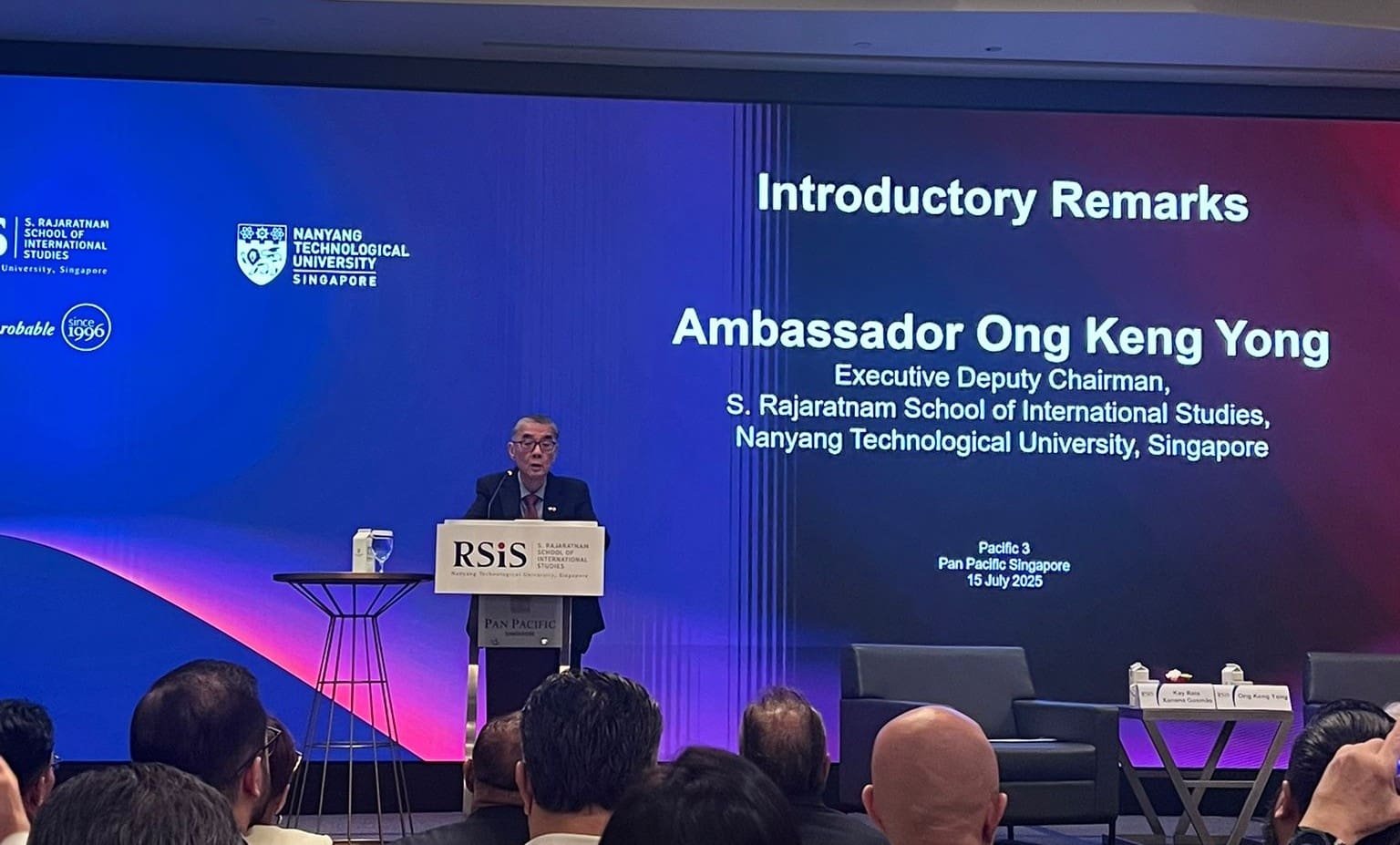
Ambassador Ong Keng Yong, Executive Deputy Chairman of RSIS and Chair of the session, welcomed the Prime Minister back to Singapore, recalling his earlier lecture in 2013. “We are deeply honoured to welcome Prime Minister Gusmão again. His leadership remains pivotal to Timor-Leste’s independent journey and ongoing development,� said Ambassador Ong.
In his address, Prime Minister Gusmão offered a wide-ranging reflection on Timor-Leste’s history, its aspirations as a small and developing nation, and its growing role in regional and global diplomacy. From the legacy of colonialism and the struggle for independence to state-building and peace consolidation, he highlighted both the progress achieved and the challenges ahead. “Our journey has not been easy — from occupation to independence, and now to integration and development. We must prepare our people not just to survive in this changing world, but to contribute meaningfully to it,� said PM Gusmão.

Touching on geopolitical shifts, climate concerns, artificial intelligence, and the erosion of international legal norms, Gusmão noted that global uncertainty requires strengthened multilateralism and renewed commitment to cooperation. He reaffirmed Timor-Leste’s belief in ASEAN as a force for regional stability and inclusivity. “ASEAN is not just an institution—it embodies a culture of consensus, cooperation, and mutual respect. As a small state, Timor-Leste sees value in this model and is committed to contributing to it meaningfully,� the Prime Minister stated.
PM Gusmão also acknowledged Singapore’s developmental trajectory as a source of inspiration. “Singapore is an example of resilience and long-term strategic leadership. While we differ in circumstances, we share the same need to be adaptable, forward-looking, and united,� he remarked.
The lecture was followed by a moderated dialogue, where Prime Minister Gusmão addressed questions from students and policy experts. One key theme was human capital development. In response to a question by Ambassador Ong about the main obstacle to Timor-Leste’s economic transformation, Gusmão emphasised the importance of education and institutional capacity.

“The number one challenge we face is human resource development. Without a clear vision and a capable population, progress will be limited. We are investing in education at all levels—primary to university—to equip our people for the future,� he said.
Another question focused on the free movement of people within ASEAN. Gusmão and his team explained that Timor-Leste was in the final stages of negotiating ASEAN agreements related to trade in goods and services, investment, and the movement of natural persons. These commitments, aligned with the country’s recent accession to the World Trade Organization (WTO), aim to ensure that Timor-Leste enters ASEAN as a well-prepared and fully contributing member.
Education and institutional reform remained dominant themes throughout the discussion. Gusmão highlighted the country’s progress in building state capacity over the past two decades, while also acknowledging the long road ahead. “State-building is not just about establishing structures; it’s about ensuring that those structures are populated with people of integrity and capability. We are still developing, but we are committed to doing so with purpose,� he said.
The RSIS Distinguished Public Lecture provided a timely platform for regional stakeholders to engage with Timor-Leste’s leadership on its vision for the future. As ASEAN contemplates its next phase of development amid a shifting global landscape, the potential accession of Timor-Leste carries both symbolic and strategic significance.
In closing, Gusmão noted that despite ongoing global instability, regional institutions like ASEAN—and academic platforms like RSIS—play an increasingly vital role in shaping a cooperative, rules-based order. “We are not merely seeking membership; we are seeking to contribute,� he concluded.